
RamaX allows us to screen large naive or AI-designed libraries with incredible speed (<1 week) -- but how accurate is it?
In this case study, we evaluate RamaX’s ability to screen minibinders, showing that it achieves exceptional performance on both controlled benchmarks and real-world partner projects.
We first benchmark RamaX on a pooled library of minbinders against three therapeutic targets, already validated via Surface Plasmon Resonance (SPR). RamaX achieves high precision and recall across targets, recovering even weak μM binders while maintaining a low false positive rate.
We then present data from two successful partner projects on AI minibinder design. Here we use our DSG AI models to design thousands of minibinders and screen them with RamaX with an end-to-end turnaround time of <2 weeks from design to RamaX library scale screening to SPR validation data.
Finally, we use RamaX Opt to simultaneously affinity-mature eight parental minibinders across the three benchmark therapeutic targets, producing variants with up to 100× improved binding affinity in a single one-week screening cycle.
Miniprotein binders (or “minibinders”) are small proteins, typically 50-200 amino acids in length, that are designed to bind to a specific target.
To evaluate RamaX’s accuracy for screening libraries of minibinders, we benchmarked it against a library of AI-designed miniproteins with independently established binding labels from SPR (Table 1). This benchmark set deliberately spans strong and weak binders ranging from pM to μM affinity (Figure 1). Because RamaX screens all candidates in a single pooled assay, the three targets could be tested together, enabling efficient and low-cost screening.
Target
# screened on SPR
# binders
# non-binders
TrkA
102
7
95
PD-L1
104
18
86
CTLA-4
85
28
57
Table 1. Composition of the SPR-validated minibinder benchmark set for each target.
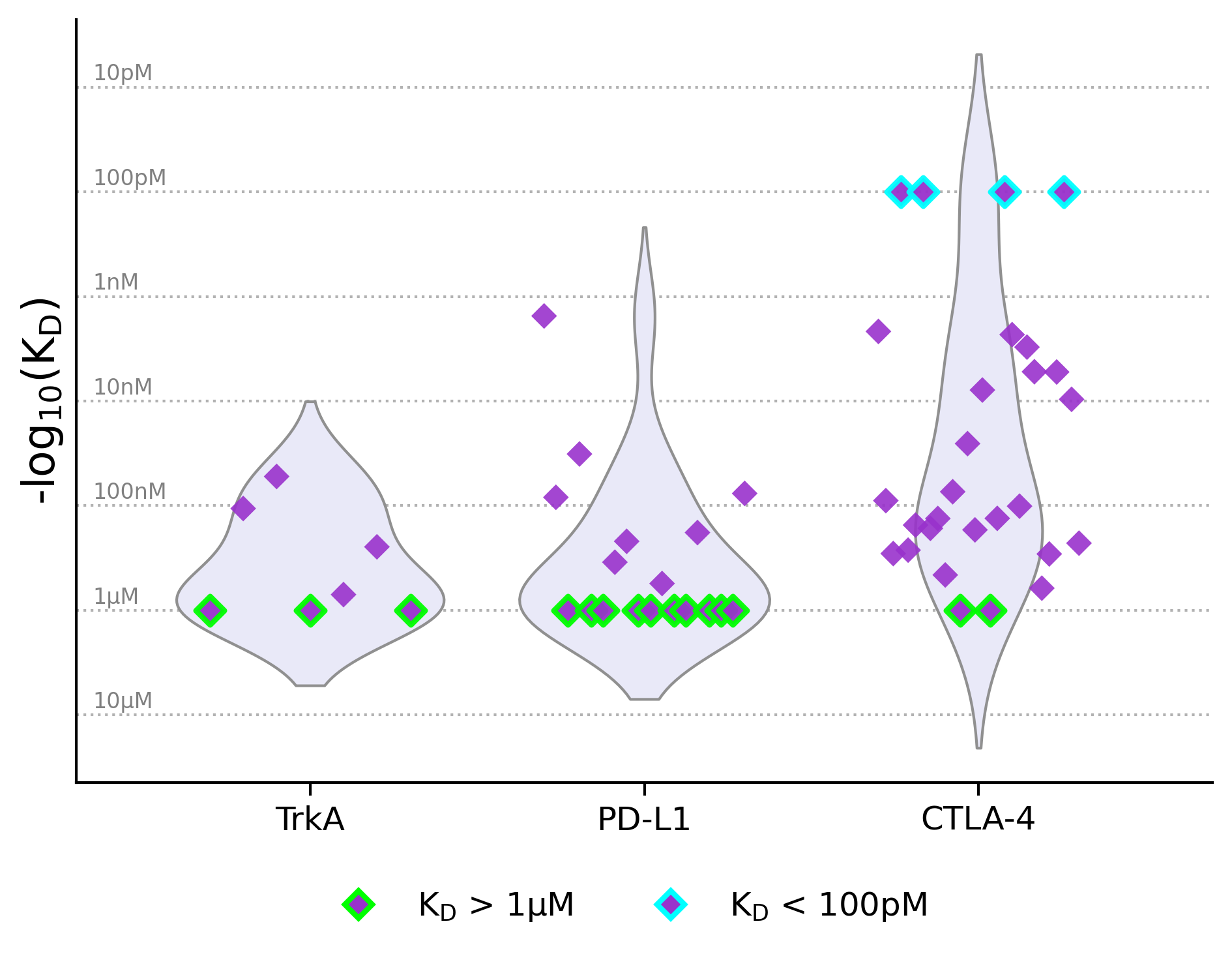
Figure 1. The benchmark set spans a wide range of affinities. The plot shows the distribution of SPR-measured affinities for the validated binders across all three targets. Binders outside the reliable SPR quantification limit should be interpreted as KD > 1 μM (green outline) or KD < 100 pM (blue outline) rather than as exact values.
From a single round of library-scale screening, we derived a RamaX Score for each molecule based on assay readouts. This score serves as a proxy for binding: high-scoring sequences correspond strongly with binders, while low-scoring sequences are predominantly non-binders.
We then evaluated the accuracy of the RamaX screen:
RamaX achieves high recall with a low false positive rate, consistently identifying over 75% of binders with a false positive rate as low as 15% across all benchmarked targets (Figure 2).
RamaX screens large pools of designs, with high accuracy -- making it a strong and cost-effective binder screening platform.
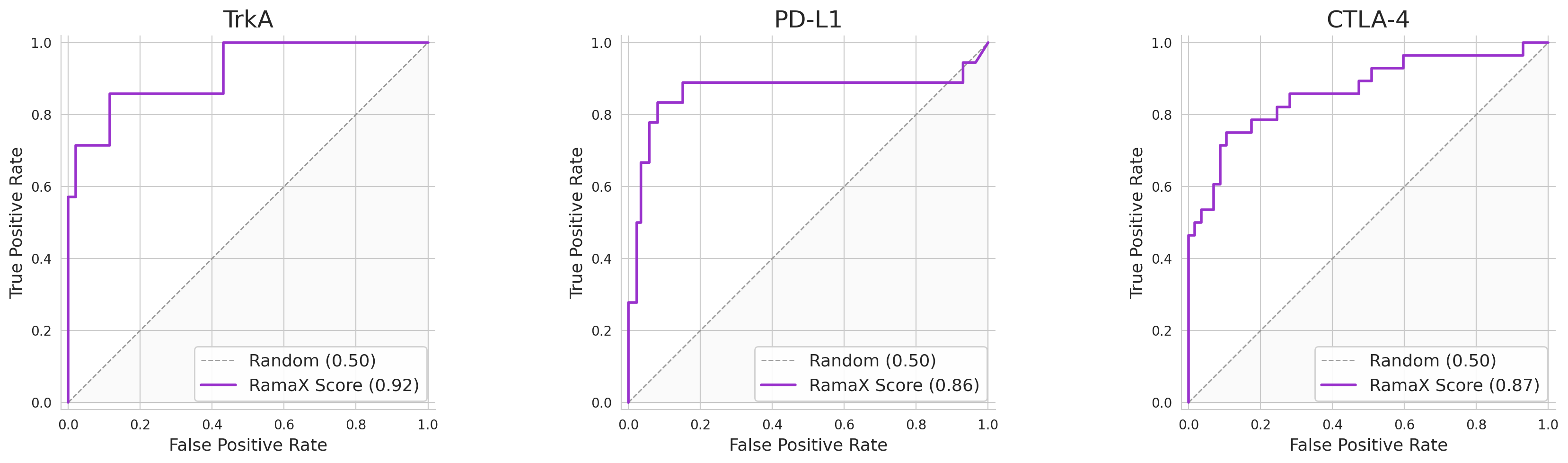
Figure 2. ROC curves for the RamaX Score across the three antigens (TrkA, PD-L1, CTLA-4). Each panel plots true positive rate against false positive rate across classification thresholds of the RamaX Score, with AUC shown in parentheses. The dashed diagonal indicates a random classifier (AUC = 0.5).
Several partners are already running our end-to-end workflow for AI minibinder design and RamaX screening against their own targets, with applications spanning novel therapeutics, diagnostics, and reagents. Here, we highlight two anonymized minibinder design campaigns. In each case, the partner went from target and epitope specification to SPR-validated hits in under two weeks: one week for computational design and DNA synthesis, and less than a week for RamaX library screening and SPR.
Partner Project # 1 -- Rapid minibinder reagent design. We used to design and finalize a library of 2,000 minibinders with our AI models, performed screening with RamaX, and selected 23 sequences for SPR validation based on their RamaX Score. We found single-digit nanomolar binders in <2 weeks.
Partner Project # 2 -- Rapid minibinder therapeutic design against a specific protein domain. We used our DSG AI models to design and finalize a library of 6,000 minibinders with our AI models, performed screening with RamaX, and selected the top 50 sequences for SPR validation based on their RamaX Score. We found a 150nM binder against the domain of interest in <2 weeks.
Across both campaigns, RamaX allowed us to find several hits (Figure 4) with high precision (Table 2).
.png)
Figure 4. Isoaffinity plot (kd vs ka) of the SPR-validated binders from the 2k library for Partner Project #1 (left) and the 6k library for Partner Project #2 (right). Lower-right indicates tighter binding. Controls (green star) are shown for reference. Inset: an example 1:1-binding SPR sensorgram.
Total Count (N)
Top-10 Precision
Top-20 Precision
Top-N Precision
Partner Project #1
23
100%
100%
100%
Partner Project #2
50
80%
45%
18%
Table 2. Top-K precision (K = 10, 20, N) for the two partner campaigns. N is the total number of designs screened on SPR for that project.
Importantly, RamaX substantially outperforms purely computational metrics for identifying true binders. For comparison, ranking designs by ipTM score from Boltz2 refolding, a common strategy for selecting candidates for experimental testing, fails to prioritize the strongest binders in these campaigns. In Partner Project #1, the tightest binder ranks 152 out of 2,000 by ipTM, while in Project #2, the top binder ranks 2,225 out of 6,000. In contrast, RamaX is extremely effective at finding true binders in large libraries, including those that computational ranking does not identify.
We took seven parental minibinders from our benchmarking pool across the three targets, mutagenized these, and screened the mutagenized library on RamaX Opt. We then selected a subset of top variants using the RamaX Score, and validated this subset via SPR.
RamaX Opt produced affinity-matured variants for all three targets in a single screen, with improvements of 100× over the parentals in a single one-week cycle (Figure 3).
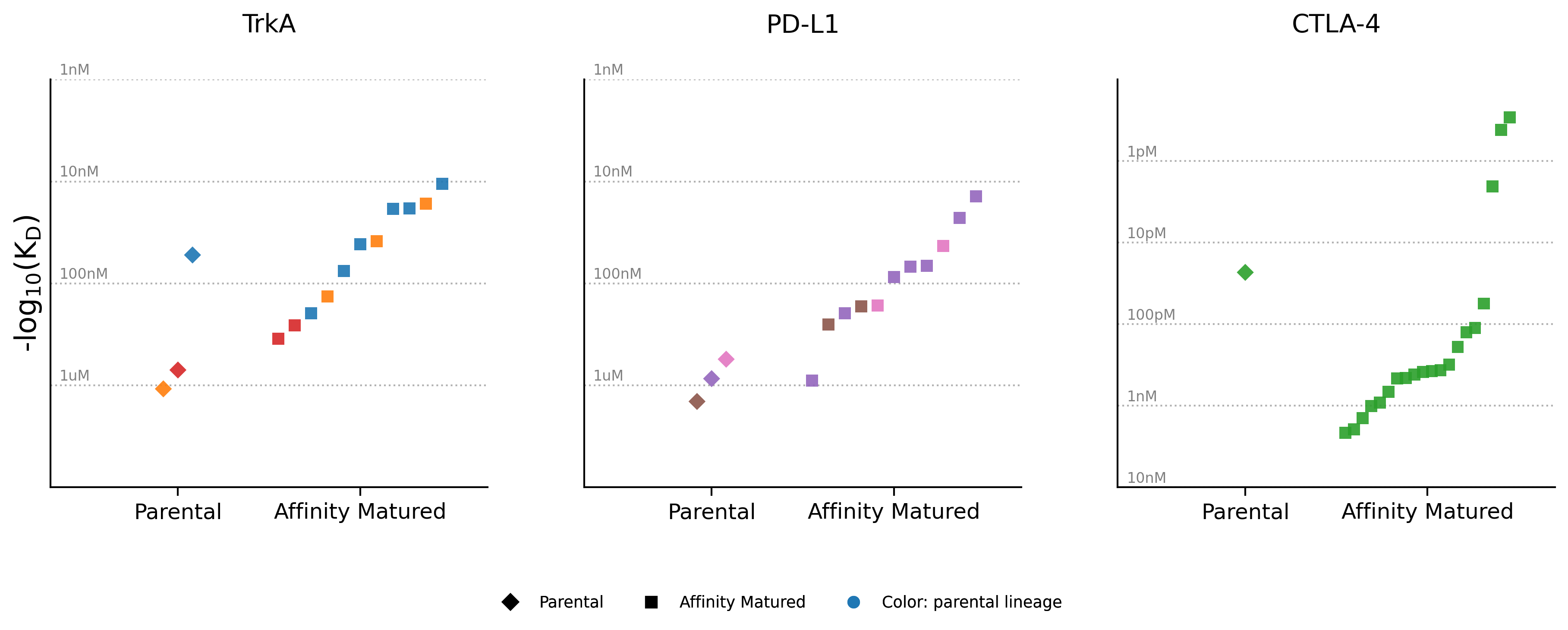
Figure 3. SPR-measured KD values for the parental minibinder sequences and their RamaX Opt-matured variants. Within each panel, sequences are ranked by affinity and colored by parental lineage.
RamaX Opt's ability to explore a wide region of sequence space makes it well suited for optimizing minibinders across diverse targets. Further rounds, each seeded by the previous round's leads, would push deeper into sequence space to recover more diverse and tighter binders.
With RamaX, our goal is to get the time and cost per molecule screened as low as possible. For our partners, that means more valuable molecules found, faster.
At Diffuse, a primary focus area is generating massive datasets to train better AI protein design models. Our RamaX speeds are important for (1) generating the most data possible per unit time and (2) finally enabling post-training with fast verified rewards in this domain.
While RamaX is valuable for partners now -- we're very excited about the data generation capabilities of the platform.
In this case study, we showcase RamaX's accuracy, achieving high precision and recall for a vaidated benchmark minibinder library, and its versatility, allowing us to screen large binder libraries across multiple targets in parallel.
Learn more about our end-to-end workflow:
Our customers are already using our platform to develop their molecules and generate large datasets at unprecedented speed.
Interested in starting a discovery campaign, or have molecules you'd like to optimize? Get started with the RamaX platform by filling out our intake form or getting in touch.
Or, work on these problems with us by joining our team!
— The Diffuse team


We are eager to connect with you
