

In this case study, we use our platform RamaX Opt to simultaneously optimize 4 parental VHHs against 4 different therapeutic targets.
In one week, we validated new binders with 10–1000x improved binding affinity, while removing known sequence liabilities. We achieved these results while screening these targets in parallel.
This closes the loop on what end-to-end binder design looks like at Diffuse:
To our knowledge, this is the fastest affinity maturation method available. Read more about RamaX Opt below, or in our updated RamaX technical report.
We started with sequences previously discovered from naive libraries or from AI design campaigns. These are:
Starting from the four parental sequences described above, we built mutagenized libraries, performed RamaX Opt screening, and screened a subset of identified binders via Surface Plasmon Resonance (SPR). Below, we compare these new measurements against their parental binding affinity:
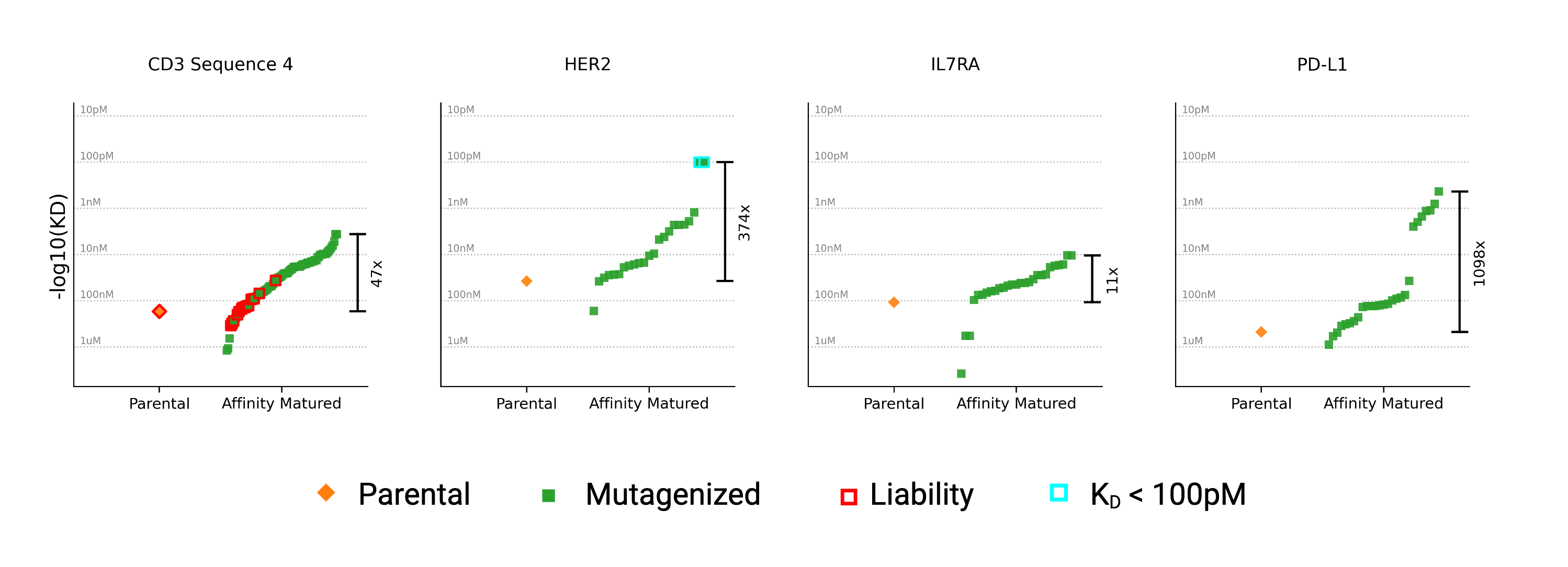
Figure 1: RamaX optimization yields affinity improvements across 4 parental binders. Each panel shows SPR-measured KD values for a parental sequence (orange) and RamaX-screened affinity-matured variants (green). RamaX Opt yields affinity improvements across 4 parental binders, and removes a known sequence liability in CD3 Sequence 4 (red outline). Variants with affinities below the reliable SPR quantification limit should be interpreted as KD < 100 pM rather than as exact values (blue outline).
Across all four lineages, RamaX Opt produced matured variants 10–1000× tighter than the parental in a single 1 week screening cycle. For the anti-CD3 lineage, an identified sequence liability was removed in the same cycle. Matured variants without the liability matched or exceeded the affinity of variants that retained it.
The ceiling for improvement after one round of mutagenesis and screening is dependent on the parental sequence itself. Screening many parentals in parallel on RamaX Opt increases the likelihood of finding leads with the ideal affinity profile. And for further optimization, further rounds of mutagenesis seeded by the lead designs of each previous round will allow deeper exploration of sequence space.
In this case study, we also measured how far RamaX Opt could explore in sequence space in a single, one-shot experiment, simply by screening very high diversity libraries.
The areas of the sequence allowed to mutagenize were as follows:
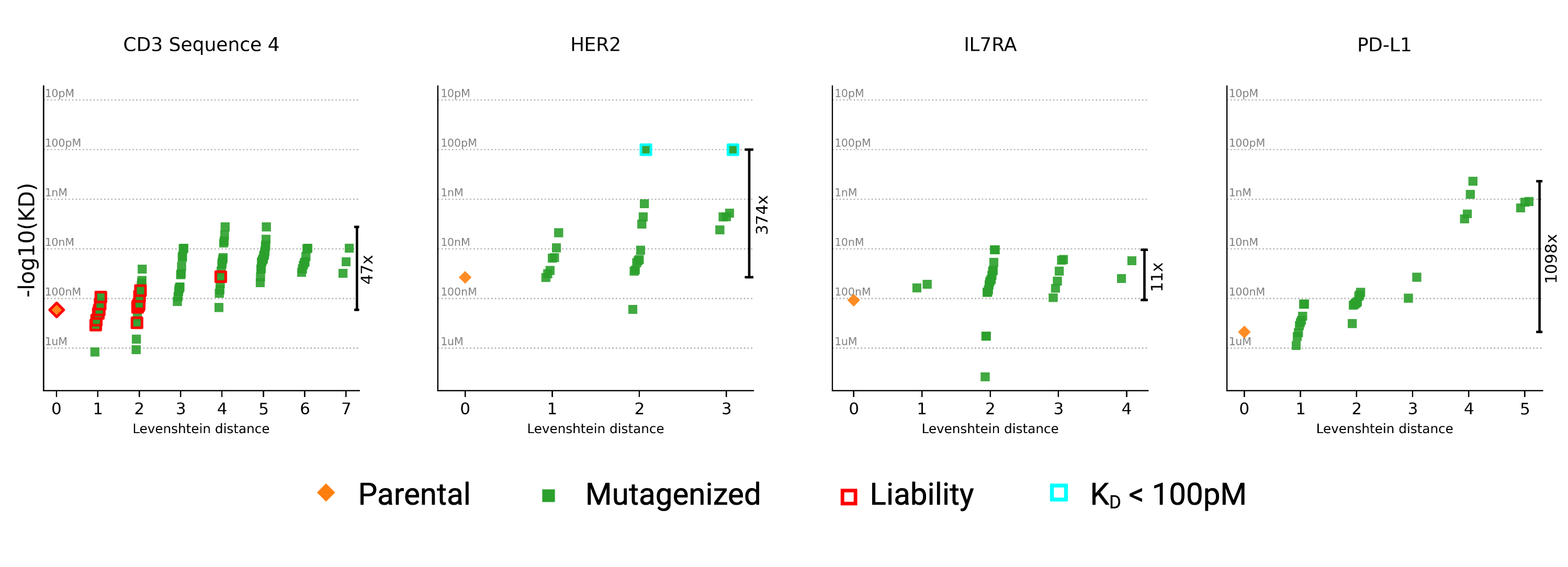
Figure 2: RamaX Opt identifies validated tight binders across a range of sequence distances from the parental. SPR-measured KD values of affinity-matured variants (green) are plotted against Levenshtein distance from the parental sequence (orange) for each lineage. Liability-containing variants for anti-CD3 only are outlined in red; variants with affinities below the reliable SPR quantification limit are outlined in blue. In one round of mutagenesis, improved variants are recovered across the full mutational range of each library.
RamaX Opt identifies validated tight binders across a wide range of sequence distances. For anti-CD3, where mutagenesis spanned all three CDRs, matured variants reached regions of sequence space substantially beyond the parental. For the PD-L1 library, the tightest variants (sub-nM hits) were found at meaningful Levenshtein distance from the parental.
This level of diversification is possible because RamaX Opt can screen very large mutagenesis libraries in a single cycle, so the search isn't restricted to the immediate neighborhood of the parental.
Finally, we inspected how the RamaX Opt platform improved the binding affinities (KD) of parental binders.
Two variants with the same KD can behave very differently in vivo, because the overall tightness of interaction between a binder and target is determined by their rate of association (ka) and dissociation (kd).
Here we found that RamaX Opt simultaneously improved both rate constants across all four targets. Matured variants move diagonally toward the top left corner of the grid: faster on-rates and slower off-rates. Kinetic refinement on RamaX Opt did not trade off one property for another, while exploring new regions of sequence space.
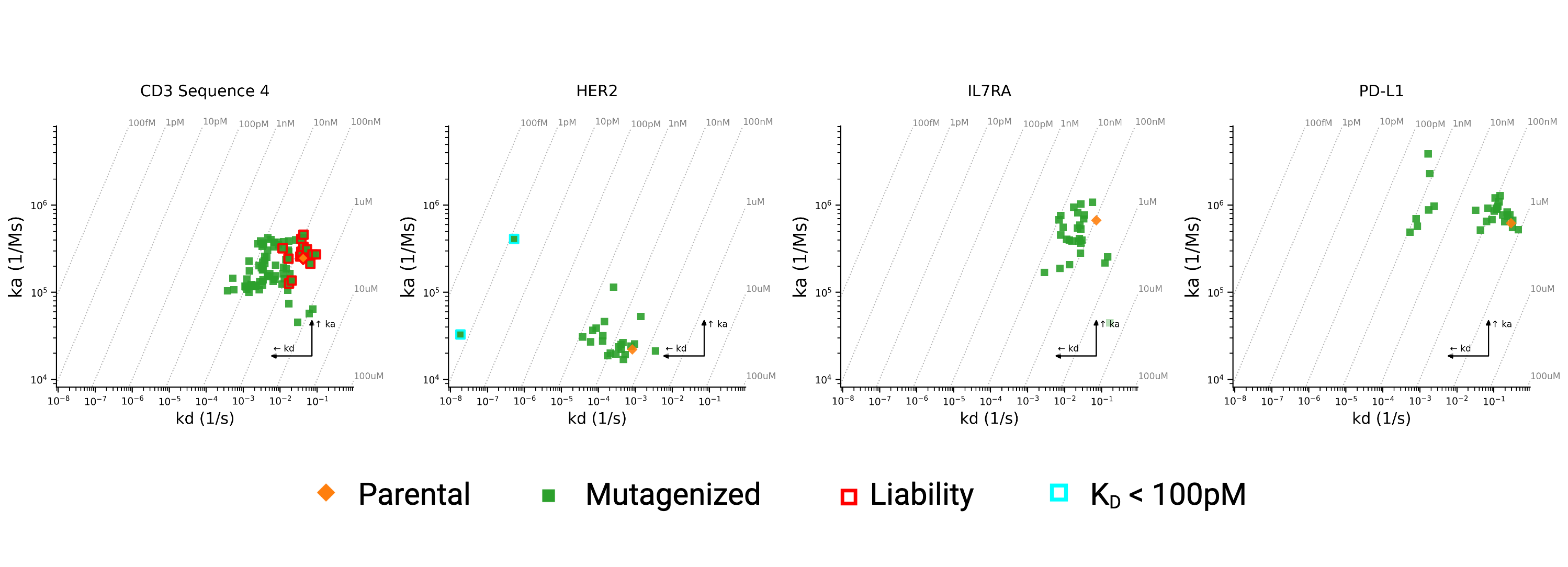
Figure 3: RamaX Opt simultaneously improves both ka and kd across all four lineages. Isoaffinity plots of ka (y-axis) vs. kd (x-axis) are shown for each lineage, with dashed lines indicating KD. Parentals are in orange; matured variants are in green; liability-containing variants for anti-CD3 only are outlined in red; variants with affinities below the reliable SPR quantification limit are outlined in blue.
Behind the scenes, we're already using this workflow for a combination of engineering objectives. In a single round of mutagenesis, RamaX Opt can do:
RamaX Opt handles this all in the same screening cycle, all in one week.
If you have a protein you'd like to optimize, or a discovery campaign you'd like to start from scratch, get started with the RamaX Opt platform by filling out our intake form.
Or, work on these problems with us by joining our team!
At Diffuse, we're developing the experimental assays to make biological measurements at unprecedented speed and scale. We believe this will unlock the future of protein engineering, modeling, and design.
— The Diffuse team



We are eager to connect with you.
